How to thaw a turkey safely without losing cooking day
Start with the package weight and the time the turkey must enter the oven. This planner turns USDA thawing guidance into a refrigerator reservation, a start date, and a backup decision.
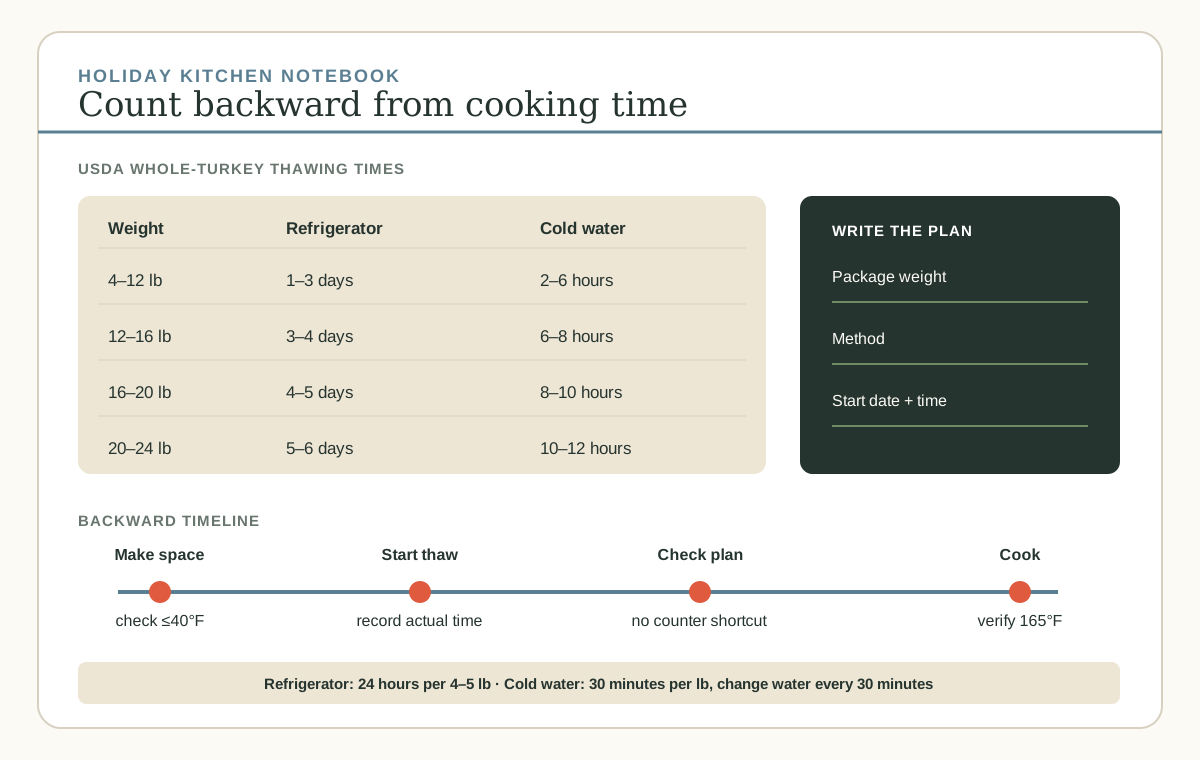
Write down weight, method and cooking time
A turkey plan begins with the weight printed on the package, not a visual estimate or the number of guests. Keep the original label available because it also holds product-specific handling and cooking instructions. Then write the exact time the turkey needs to go into the oven or other approved appliance. “Thanksgiving morning” is too vague to count backward from.
Choose the thawing method before choosing a start time. USDA Food Safety and Inspection Service guidance gives different handling rules for each method:
- Refrigerator: keep the appliance at 40°F or below, allow about 24 hours for every 4 to 5 pounds, and place the wrapped turkey in a container that catches leaks.
- Cold water: keep the turkey in a leak-proof bag, submerge it in cold tap water, change the water every 30 minutes, allow about 30 minutes per pound, and cook immediately.
- Microwave: confirm that the turkey fits, follow the microwave manufacturer's defrost instructions, and cook immediately because portions may become warm or begin cooking.
These methods are not interchangeable calendar entries. A refrigerator-thawed turkey may remain refrigerated for one or two days before cooking. A cold-water or microwave-thawed turkey does not receive that holding window.
Use the USDA refrigerator-thawing chart
Refrigerator thawing is slow, passive and easiest to schedule, but only when the refrigerator has room and stays at 40°F or below. Put the turkey on a rimmed tray or in a container large enough to contain drips. Store it where raw juices cannot reach produce, desserts, cooked food, or other ready-to-eat items. Follow the refrigerator manufacturer's placement and airflow instructions.
| Whole turkey weight | USDA refrigerator thaw time | Practical calendar move |
|---|---|---|
| 4 to 12 lb | 1 to 3 days | Reserve up to three full days, then add the chosen 1–2 day refrigerated holding margin only if needed. |
| 12 to 16 lb | 3 to 4 days | Move to the refrigerator at least four full days before the planned prep time. |
| 16 to 20 lb | 4 to 5 days | Reserve five full days and verify shelf space before shopping. |
| 20 to 24 lb | 5 to 6 days | Reserve six full days; check refrigerator temperature and tray fit before the turkey arrives. |
The chart is approximate. A crowded refrigerator, a very cold zone, package shape, and the exact weight can affect the thaw. Use the longer end of the range when planning. Do not raise the refrigerator temperature to accelerate thawing.
Count in complete 24-hour blocks from the moment cooking-day preparation begins. If a 15-pound turkey must be ready for preparation at 9 a.m. Thursday, four full thawing days point to 9 a.m. Sunday as the latest chart-based start. Moving it Saturday adds planning margin and still stays within USDA's one-to-two-day refrigerated holding window after it has thawed. Record the actual move time on the planner.
Reserve refrigerator space before the turkey arrives
The turkey is not the only holiday food competing for cold storage. Desserts, dairy, produce, thawing frozen ingredients and safely cooled make-ahead dishes all need space. Run the site's pantry-first weekly reset one week before cooking. Use safe short-dated food, remove items that no longer belong, and consolidate only when labels and handling history remain clear.
Place an appliance thermometer where it can be read without moving the turkey. A control dial setting is not a temperature measurement. If the appliance cannot hold 40°F or below, it is not a safe thawing plan. Avoid blocking vents, overfilling shelves, or placing a heavy bird on a shelf that cannot support it.
Choose the thawing container before purchase. Check its inside length, width and depth against the expected package, and verify that both the container and turkey will fit on the selected shelf without touching ready-to-eat food. Wash hands and clean and sanitize any surface that contacts raw turkey juices according to current USDA guidance.
Cold-water thawing is a supervised shift
Cold water is faster than the refrigerator, but it is active work. USDA says to allow about 30 minutes per pound. The turkey must remain in a leak-proof plastic bag to prevent cross-contamination and water absorption. Submerge it in cold tap water and change that water every 30 minutes until thawed. Cook immediately.
| Whole turkey weight | USDA cold-water thaw time | Half-hour water changes |
|---|---|---|
| 4 to 12 lb | 2 to 6 hours | About 4 to 12 changes |
| 12 to 16 lb | 6 to 8 hours | About 12 to 16 changes |
| 16 to 20 lb | 8 to 10 hours | About 16 to 20 changes |
| 20 to 24 lb | 10 to 12 hours | About 20 to 24 changes |
Those water-change counts reveal the real cost of the method. A 20-pound turkey is not a “morning shortcut”; it may require ten hours of monitored thawing and around twenty water changes before cooking starts. Confirm that a clean food-safe sink or container is available for the full shift and that the cook can maintain the schedule without leaving the turkey unattended.
Keep dishware, vegetables and ready-to-eat food away from the thawing area. Treat the package exterior and water as part of the raw-poultry zone. When finished, clean and sanitize the sink, container, faucet handles and nearby surfaces following product and USDA directions. Do not use cold-water thawing if the packaging leaks and cannot be enclosed securely.
Microwave thawing depends on the appliance
USDA does not give one universal microwave time. Use the microwave manufacturer's instructions for bird size, power level, rotation and standing time. Confirm the turkey and its wrapping are compatible with the appliance. A whole holiday turkey often will not fit or turn safely.
Cook immediately after microwave thawing. Some areas may warm or begin to cook during defrosting, and holding partially cooked poultry is not recommended. The cooking appliance, pan and recipe must already be ready. Do not microwave-thaw in the evening for roasting the next morning.
If the manufacturer's directions do not cover the turkey's weight and shape, choose another approved method. Improvising a microwave time from a different appliance or smaller bird is not a safe plan.
Do not use the counter, porch, garage or hot water
A frozen center does not protect the thawing surface. USDA warns that a package of meat or poultry left on the counter for more than two hours is not at a safe temperature even when the middle remains frozen. The outer layer can enter the 40°F to 140°F “Danger Zone,” where bacteria can multiply rapidly.
Unmonitored outdoor or utility spaces are not refrigerators. A cold porch, car trunk, basement, garage or snowbank can change temperature, expose food to animals or contamination, and provide no reliable proof that the turkey stayed at 40°F or below. Hot-water thawing is also unsafe. Use one of the three approved methods.
If a turkey has been thawing by an unsafe method and its time or temperature history is uncertain, do not taste it to decide. Contact the USDA Meat and Poultry Hotline or local public-health authority for case-specific advice; when safety cannot be established, discard it.
Build the cooking-day handoff
The thaw plan ends when safe preparation begins. Keep raw poultry separate from ready-to-eat food and do not wash the turkey; splashing can spread raw juices around the sink and kitchen. Follow the package and USDA preparation directions. Wash hands with soap and water for at least 20 seconds before and after handling raw poultry, and clean and sanitize affected surfaces.
USDA's current Thanksgiving guide says cooked turkey must reach at least 165°F. For a whole bird, measure the thickest part of the breast, the innermost part of the wing and the innermost part of the thigh without touching bone. If the turkey is stuffed, the center of the stuffing must also reach 165°F. A timer or browned skin cannot replace a food thermometer.
Approximate roasting charts are planning aids. USDA notes that partial freezing, stuffing, oven accuracy, pan size, rack position and blocked heat circulation can all alter cooking time. Build buffer into the meal schedule and let verified temperature, not the serving clock, determine doneness.
What if the turkey is still icy?
First, do not move it to the counter or hot water. If enough supervised time remains, the USDA cold-water method can complete thawing, followed by immediate cooking. If the bird fits the microwave and the manufacturer provides instructions, microwave thawing is another immediate-cook option.
USDA's Thanksgiving cooking calculator also includes cooking from frozen as a method, but instructions, equipment fit and cooking time differ. Use the current USDA directions for that route rather than treating a frozen bird like a thawed one. Never deep-fry a frozen or partially frozen turkey; water and hot oil can create a violent hazard.
When plans change, revise the meal rather than forcing an unsafe shortcut. Serve shelf-stable starters, move side dishes later, or use another safely handled main dish. The pantry's five-meal buffer can supply a low-stress backup that does not compete for the turkey's refrigerator space.
Turn one turkey into a dated kitchen record
Write these six lines
- Weight: exact package weight and product instructions.
- Method: refrigerator, cold water, or microwave.
- Start: date and time thawing begins.
- Checks: refrigerator temperature or each half-hour water change.
- Cook: planned appliance start and actual start.
- Verify: 165°F readings at the USDA measurement points.
Keep the record with the meal plan. If the turkey moves from freezer to refrigerator, write the actual time. If cold-water thawing starts, create repeating 30-minute reminders and initial each completed change. If the cooking plan changes, update the record instead of relying on memory across a busy kitchen.
After the meal, switch to the site's four-day Thanksgiving leftovers plan. Record when perishable food left temperature control, refrigerate safely handled portions within the USDA time limit, and mark the use-or-freeze deadline. The thawing planner and leftovers plan together cover the two points when holiday food is most likely to lose its time-and-temperature history.
Frequently asked questions
How long does a turkey take to thaw in the refrigerator?
USDA says to allow about 24 hours for every 4 to 5 pounds at 40°F or below. Its whole-turkey chart ranges from one to three days for 4 to 12 pounds up to five to six days for 20 to 24 pounds.
Can a turkey thaw on the counter overnight?
No. USDA says counter thawing is unsafe because the exterior can warm into the 40°F to 140°F Danger Zone while the center remains frozen.
Can I refreeze a refrigerator-thawed turkey?
USDA says food thawed in the refrigerator can be refrozen without cooking, though quality may decline. A cold-water- or microwave-thawed turkey should be cooked immediately; cooked meat may then be frozen.
How long can a thawed turkey stay refrigerated?
A turkey thawed in the refrigerator can remain there for one or two days before cooking. Other thawing methods require immediate cooking.
What temperature must turkey reach?
USDA requires a minimum internal temperature of 165°F. For a whole turkey, check the thickest breast and the innermost wing and thigh, avoiding bone. Stuffing inside the bird must also reach 165°F.
Sources
Reviewed October 30, 2026. Follow the current product label, appliance instructions and USDA FSIS guidance. For a specific meat or poultry question, use the USDA Meat and Poultry Hotline listed in the Thanksgiving guide.